Most employees are taking the initiative to reskill for the AI era. HR leaders on the other hand, are lagging behind.
The Conference Board reports that only 7% of CHROs are reskilling employees, even though 25% of what those employees do can be taken over by AI. As for employees, learning opportunities can determine whether to stay with their employer or leave for another job.
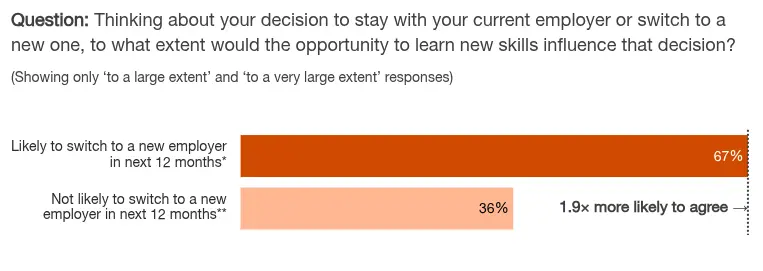
Source: PwC
This situation is creating a skills gap that can hinder companies’ ability to compete and meet their goals. As AI keeps advancing, it’s important that HR leaders take action to prepare their workforce for the AI era.
Set the Stage With Skills Mapping
The first step in bridging this skills gap is to conduct a skills audit. Here are some ideas to consider:
- Leverage AI-powered workforce analytics. This will help map the current skills landscape and predict skills gaps
- Align the needed skills with the company’s AI adoption strategy
- Start engaging employees early to reduce resistance to change
Once you know where the workforce currently stands in terms of AI skills, then building an effective reskilling program becomes easy.
Building an AI-focused Reskilling Program
Building an AI-focused reskilling program doesn’t have to be complicated. Here are five steps to follow.
1. Link Learning Objectives to Business Outcomes
Design your reskilling program with learning objectives that connect to business outcomes. Not only will this show employees how their new skills will contribute to business success, but will also help with executive-level buy-in.
Here’s how this could look like:
- Increase internal mobility by 15%
- Reduce external hiring for AI roles by 50%
- Improve employee retention in AI-impacted roles by 20%
2. Choose an AI-powered Learning Platform
Many HRM systems include a Learning Management System (LMS) where courses can be created and course completion certificates generated. While these work fine, why not embrace AI-powered learning platforms?
Here are some advantages of using an AI-powered LMS:
- Personalized learning experiences: AI systems can personalize learning paths and proactively recommend relevant learning resources
- Increased engagement: with features like intelligent feedback loops and gamification, learning becomes engaging and fun, encouraging course completion
- Improved analytics and decision making: an AI-powered learning platform provides deep insights into training effectiveness and helps make data-driven decisions
Some of the best AI-powered learning platforms are 360Learning, Paradiso Solutions, and Docebo.
3. Include Diverse Learning Formats
Since employees learn differently, it’s best to provide diverse learning formats.
This can include combining in-person workshops with online courses, creating bite-sized courses for employees with busy schedules, or providing peer coaching opportunities.
For digital content formats, having the option to download PDF, audio, or video files for later consumption can also help with learning.
4. Provide Incentives and Recognition
While employees may want to take AI literacy courses for Fear of Becoming Obsolete (FOBO), it’s better to motivate them with incentives and recognition.
This can included giving them digital badges, promotions, or even highlighting them on an employee wall of fame.
5. Embed Continuous Learning into the Workplace Culture
An effective reskilling program should accommodate continuous learning, especially for AI, a field advancing at a very fast pace.
Here are some ideas:
- Link skill-building to performance reviews: let employees know that upskilling, especially on AI, will form part of their performance review
- Implement knowledge sharing and mentorship: create collaboration forums and mentorship programs where experienced staff train others
- Promote a growth mindset: encourage curiosity and critical thinking, and urge employees to take feedback and peer coaching as opportunities for growth
Overcoming Barriers to Reskilling
Just as is the case with many business initiatives, there are barriers to reskilling. Here are four major ones, and ways to overcome them.
- Budget constraints: instead of going all out with training, start with a phased pilot. AI-powered learning platforms can help cut costs since they are scalable
- Learning fatigue: break down courses into bite-sized modules that make learning easy
- Inclusivity challenges: use different learning formats to make courses accessible to employees with diverse needs
- Proving ROI: track and measure improvements in areas such as employee retention, promotions, project success, etc, to show business value
Building a Future-ready Workforce
As AI continues to make headlines and change how businesses operate, the question for HR leaders is: will your workforce thrive or fall behind?
By implementing an AI-focused reskilling program, HRs will be communicating the company’s commitment to its people and their future. This helps turn employee uncertainty into confidence, and disruption into opportunity.
If you need help designing a future-proof reskilling program that builds employee capacity and trust, let’s talk. Just fill our consultation form and together, we’ll prepare your workforce for long-term success in this AI era.