AI changed how we search. Now AI adoption is redefining how we work.
From automating routine tasks to altering and replacing roles, AI is presenting both challenges and opportunities.
As a business leader or department head, how can you adopt AI without the risks?
Here are some of the challenges and opportunities involved, followed by a strategic guide to help you succeed in your AI transformation journey.
Top 3 Challenges of AI Adoption
There are many challenges different organizations face in their AI adoption journey. Here are the top 3 you should prepare for:
- Skills gap: 46% of business leaders say that a skills gap is their biggest barrier to AI adoption
- Leadership alignment: 70% of organizations’ change initiatives fail due to poor leadership and ineffective change management
- Governance and oversight issues: only 28% of CEOs are directly involved in AI governance. According to the McKinsey report, direct CEO involvement strongly correlates with positive ROI on AI investment
Opportunities That Come With AI Adoption
Meanwhile, opportunities await those who adopt AI quickly. These opportunities include:
- Productivity gains: generative AI has the potential of saving employees 60%-70% of time spent working
- Competitive advantage: AI transformations can generate up to $4.4 trillion in global corporate profits annually
- Long-term value creation: according to PwC, AI will lead to a $15.7 trillion increase in the world’s GDP by 2030
To capitalize on these opportunities, you’ll need to prioritize leadership alignment, workforce readiness, and a culture that embraces AI’s full potential.
How to Create an AI Vision and Implement It (A Strategic Guide)
Succeeding in the AI era is more about strategy than technology. Whether you’re just starting or refining your approach, this guide will help you adopt AI in a way that unlocks real business value.
Here’s the seven-step process to follow:
1. Create AI Awareness and Align Leadership
Leadership needs to go beyond buzzwords and understand what AI can and can’t do. Once this foundation is set, everyone should align on what role AI will play in the organization’s growth.
As you move into developing your company’s AI vision, ensure it reflects your values, culture, and long-term business goals. Consider the below action points:
- Organize a workshop for top leadership to discuss the role and purpose of AI adoption
- Develop an AI vision that supports existing and new growth opportunities
- Come to a mutual understanding of the business value of AI adoption (not just cost-cutting)
With a clear vision, you’ll be able to build confidence among employees and guide them in successfully adopting AI.
2. Assess Your Workforce for AI Readiness
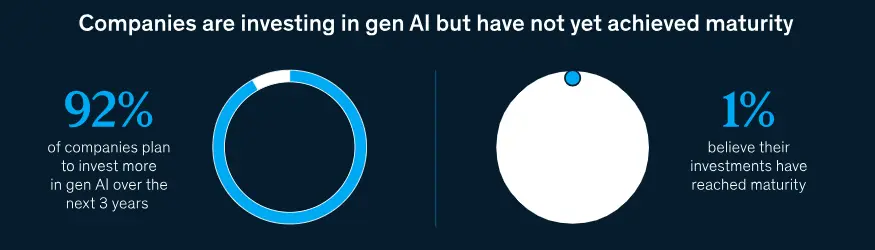
According to a January 2025 McKinsey report, while all companies are investing in AI, only 1% believe they’ve achieved maturity.
Why only 1%? Because leaders aren’t ready.
Source: McKinsey
The report shows that employees anticipate job disruptions and are eager to embrace AI, but lack the necessary support and training.
Here’s how to get out of this situation:
- Conduct a skills audit to determine current competencies and identify skills gaps
- Categorize roles into three groups: those for automation (repetitive rules-based tasks), augmentation (AI + human), and human-only roles (empathy, creativity, and judgment)
- Gauge AI-readiness in the company’s culture
Note that this assessment isn’t about eliminating jobs, but about identifying areas where AI poses risks and where it creates opportunities.
3. Develop Upskilling and Reskilling Programs
Now that you know what skills you need, it’s time to invest in learning and development. Here are some action points to guide you:
- Create training programs focused on AI literacy, data analysis, and problem solving
- Partner with educational institutions to provide learning opportunities
- Build cross-functional teams to expose everyone to AI and promote innovation and collaboration
By empowering your staff with AI skills, you’ll encourage AI adoption, drive innovation, and get the much-needed competitive advantage.
4. Integrate AI into Human Roles
With a focus on augmentation, design human-AI collaboration roles. This helps you combine the unique and expert judgment of humans with the speed and scale of AI.
Here are your action points:
- Redesign workflows to automate repetitive tasks while freeing employees for higher-value activities
- Introduce AI tools that support human decision making (e.g. AI-powered data analytics)
- Share lessons between teams to improve the success of AI adoption across the board
By focusing on augmentation, employees will see AI as a partner, and not a threat. This will help build trust and drive adoption.
5. Manage Change and Prioritize Employee Involvement
A key ingredient of successful AI transformation is strategic change management. By making employees the centre of this transformation, you can get everyone onboard, and even create excitement around AI adoption.
Here’s how you can go about this:
- Communicate transparently and frequently about the company’s AI vision and how employees will benefit from it
- Involve employees in the planning phase to get their input and reduce resistance
- Promote a culture of innovation by allowing experimentation with AI tools
- Establish feedback loops for employees to give suggestions, raise concerns, and share their experiences
With strategic employee involvement, you’ll give staff a sense of ownership and control, further boosting your AI transformation success rate.
6. Adopt AI Responsibly and Ethically
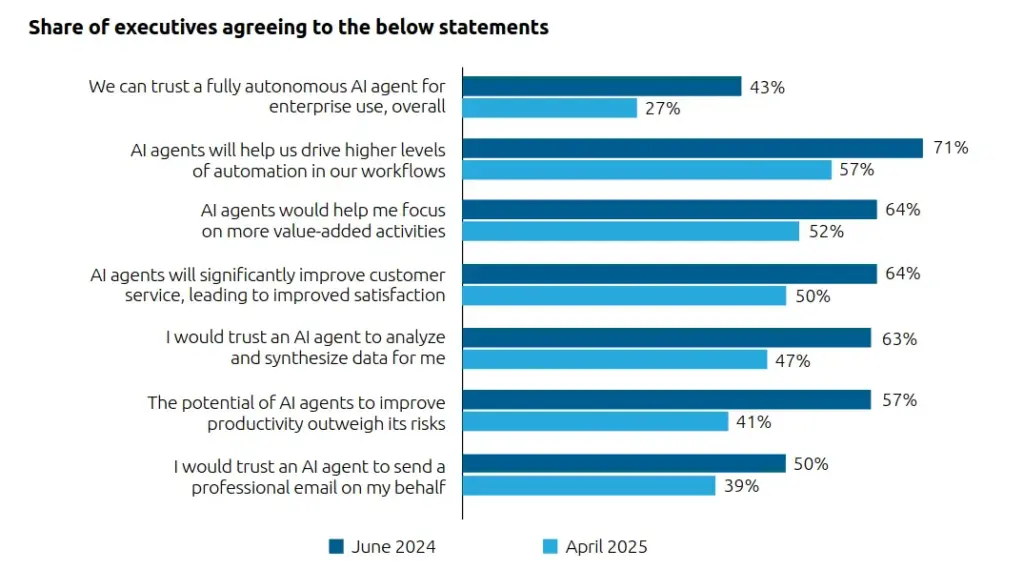
Capgemini’s Rise of Agentic AI report shows that executives are concerned about AI risks.
According to the report, in 2024, 43% of executives had trust in autonomous AI. In 2025, that trust has dropped to 27%.
Source: Capgemini
One of the biggest risks here is AI’s hallucination problem. You can however mitigate AI risks by:
- Training employees on how to write effective prompts and recognize inaccurate outputs
- Forming a cross-disciplinary committee to evaluate AI’s impact on employees and society
- Ensuring fairness and equity in AI adoption to avoid widening inequality or bias
In your AI guidelines or policy, ensure you address issues such as bias, privacy, data use, and fairness.
7. Continuously Monitor and Adapt
AI adoption isn’t a one-time project. You’ll need to monitor and adapt your AI use to fit changing business needs.
Here are some points to keep in mind:
- Regularly survey employees to track AI’s impact on their productivity, job satisfaction, and work culture
- Use insights from the survey findings to enhance workforce planning
- Monitor AI regulations, trends, and tools, and adjust your policies and strategies accordingly
By proactively evaluating AI’s use and impact, you’ll be able to keep your organization competitive and ahead of any AI-driven disruptions.
The Role of HR Leaders in AI Adoption
From promoting employee engagement to designing reskilling and upskilling programs, HR leaders will play a critical role in your organization’s AI transformation journey.
We have articles discussing these topics. On training for AI skills, read the reskilling for the AI era article. To be notified once the article on employee engagement goes live, subscribe below.
The Takeaway
As AI reshapes how we work, your role as a leader is to steer the change in a way that builds trust and confidence, and creates value for your organization and staff. With this guide, you can help your organization turn AI into a powerful advantage for long-term growth.
If you need help with AI adoption, whether creating or implementing your company’s AI vision, just reach out by filling our consultation form.