How well do you know your prospect?
While many B2B businesses use email marketing to nurture leads, email fatigue remains a key challenge. As the number of emails received increase, prospects become less engaged, unsubscribe from email lists, and even label marketing emails as spam.
Marketing emails quickly become irrelevant because marketers rely on broad assumptions when designing email campaigns. If you segment your leads based on limited criteria like industry or job title, you’ll struggle to get engagement and conversions.
For better email marketing results, you need to Know Your Prospect (KYP).
Some background…
Some time back, I went for a few days without checking my emails. When I got back to my inbox, it was overflowing with unread emails. With so many emails and so little time, I judged each email by its subject line and clicked “Mark As Read” on most.
Most of the emails were good updates but not helpful from a business perspective. These lead nurturing emails were telling me what I already knew, thus nothing really worth reading. Being a marketer myself, this got me thinking.
And that’s how I came up with the Know Your Prospect (KYP) email marketing framework.
Introducing the KYP Approach to Email Marketing
Know Your Prospect (KYP) is a data-driven strategy that nurtures leads using emails tailored to their actual needs and interests. Instead of relying only on basic segmentation, KYP uses feedback from leads to personalize content at a much deeper level.
Why KYP Works
The KYP approach to email segmenting works for the following reasons:
- It’s based on feedback: Instead of making assumptions on what leads want, they tell you.
- It leads to hyper-relevance: Leads receive emails that speak to their exact needs and interests.
- It enhances segmentation: Prospects are grouped based on real, expressed preferences, not assumptions.
- It’s adaptable: You can easily change your messaging to reflect changing preferences.
- It facilitates email automation: The more data you collect, the more effective your automated email campaigns.
Email segmentation statistics show that marketers who segment their leads see up to 760% increase in email revenue. It’s all about sending relevant messages.
The 5-Step KYP Email Marketing Framework
You can implement the KYP framework in a new email campaign, or incorporate it in existing campaigns. Here are the five steps to follow.
Step 1: Research Your Prospects
To create an effective email campaign, you need to research your prospects to understand the challenges their businesses face. This research process will help you identify the following:
- Industry pain points: What are the problems your target audience is trying to solve?
- Buyer motivations: What influences the buying decisions of your target audience?
- Behavioral insights: What topics are they researching? Where are they researching those topics?
- Preferred content formats: What content formats do they engage with? Blog articles? Case studies? Industry reports?
From this research, you can create buyer personas and use them to create personalized experiences.
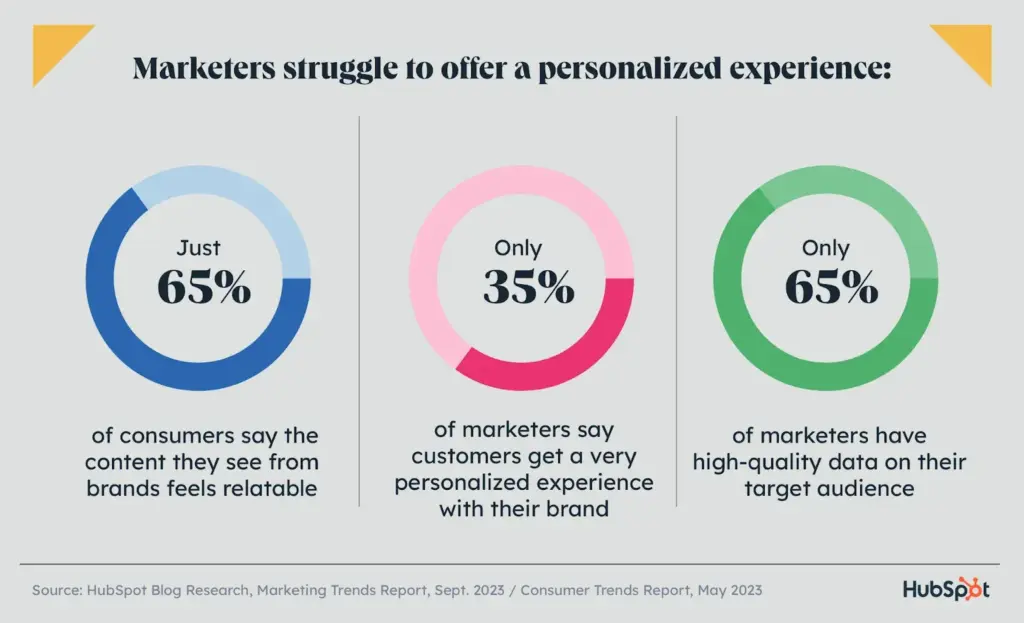
Source: HubSpot
Step 2: Generate Leads
Lead generation statistics indicate that up to 61% of marketers struggle to generate high-quality leads. But with the right information about your target audience, you can generate leads by offering valuable lead magnets such as ebooks, guides, industry reports, etc.
You can also add newsletter sign-ups on your website, create interactive content like assessments, or run webinars.
Step 3: Start Running Surveys Early
Start surveying your leads early to know what they’re most interested in. For the best results, include a short survey in the first or second email. Make the survey short, with 3-5 questions. These can cover:
- What topics are they most interested in?
- What are their biggest challenge right now?
- What are their preferred content formats (blogs, emails, videos)?
Instead of overwhelming prospects with one big survey, use progressive profiling to spread data collection across multiple emails. The first survey can cover basic interests, the second one can include more detailed questions, and after that, you can send engagement-based surveys.
Remember to spread out the surveys instead of sending them in consecutive emails. See how Aritic PinPoint increased conversion rates by 20% by implementing progressive profiling.
Step 4: Segment and Personalize Based on Survey Data
As you collect survey data, segment your leads and personalize their content accordingly.
B2B marketing statistics show that personalized emails have 41% higher click-through rates. To personalize your emails at scale, use automation to send triggered emails, drip campaigns, or even run A/B tests.

Source: Market.us Scoop
Using AI-powered email marketing tools, you can analyze survey data and engagement behavior to identify the best content for each lead. You can also use dynamic content blocks to ensure recipients only see content personalized for them.
Step 5: Track and Improve
Like other marketing efforts, the Know Your Prospect (KYP) email marketing approach requires tracking and improving. Check the usual metrics like opens, CTRs, engagements, and conversions to identify areas of improvement.
You can run A/B tests to optimize subject lines, CTAs, email content, etc, while leveraging AI-driven insights to predict the next best action for each lead.
Why KYP Is the Future of Email Marketing
Generic emails lose value quickly and prospects ignore or mark them as spam. This leads to wasted lead nurturing efforts and lost business opportunities. Just think about it: do you read emails that don’t solve the problems you face?
With KYP, you’re not just implementing an email marketing tactic. You’re making a mindset shift that helps you cut through the noise, build trust with prospects, and personalize content in an AI-powered era.
You can also combine KYP’s personalized email approach with AI search optimization strategies to amplify trust and discoverability across channels.
Conclusion
Knowing your prospect is the foundation of effective email marketing. With KYP, you get a practical framework for data collection to boost segmentation and personalization.
By including a short survey in your first email, and optimizing subsequent emails based on the survey data, you’ll see an increase in engagement, trust, and conversions.
If you would like help implementing KYP in your email campaigns, just reach out to us.